
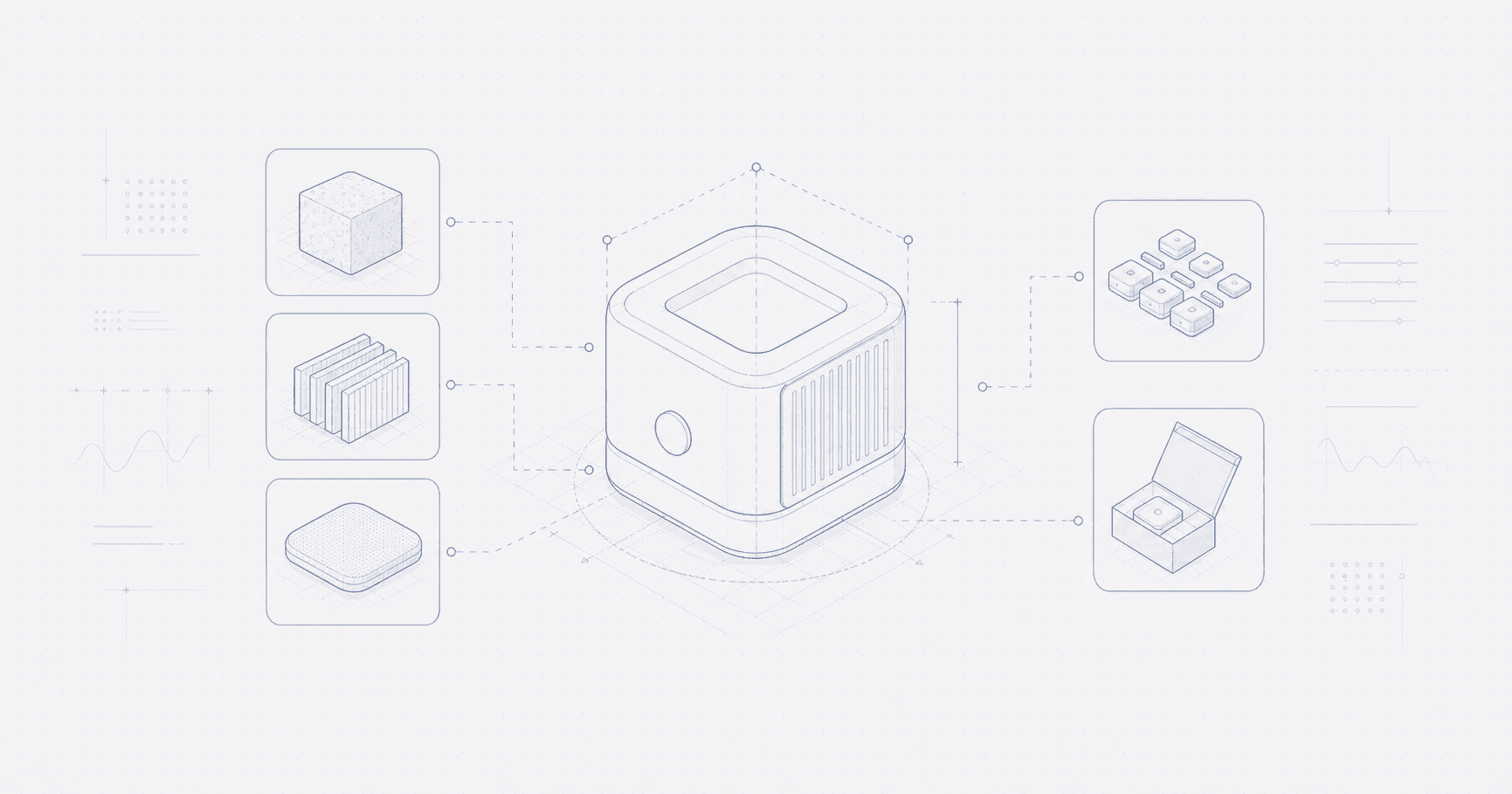
Customization starts before configuration
Most configurators start too late. They assume the product already exists and the customer only needs to choose color, size, or engraving. For unique objects, the more valuable moment is earlier: a customer describes a room, a mood, a use case, a constraint, or a material preference, and the maker helps turn that into a direction.
Niente Da Dire already sits in that space: lighting, furniture, boxes, tools, and objects designed and crafted in Liguria. AI can strengthen the first conversation by generating alternatives, showing proportion, suggesting material combinations, and making tradeoffs visible before fabrication begins.
The image is only the first checkpoint
A generated render can help a customer react quickly, but it is not the object. The real work starts when the direction becomes dimensions, parts, joints, finishes, tolerances, assembly steps, packaging, and price. AI can help draft those transitions, but the maker must decide what is structurally, aesthetically, and economically coherent.
This is where a corporate engineering studio and a craft shop reinforce each other. The shop shows the tangible result. The studio can build the product systems around it: configurators, quotation flows, production planning, product visualization, order data, and repeatable workflows for small-batch custom work.
Keep uniqueness without losing discipline
Custom does not have to mean chaotic. A good workflow can define families of objects, allowed material sets, design rules, manufacturable dimensions, and review checkpoints. Within those boundaries, AI can explore many variants while production remains sane.
That balance matters commercially. Customers get a sense of authorship. The maker keeps control of quality. The business avoids turning every order into a completely new engineering project.
From object to product line
A single custom lamp can teach a lot: which forms attract attention, which constraints customers understand, which materials photograph well, and which options create production friction. Capturing that learning turns craft into a product-development loop.
The same AI-assisted workflow can then support a company launching physical products: concept exploration, variant testing, landing pages, quote flows, and early demand signals before committing to inventory or tooling.