
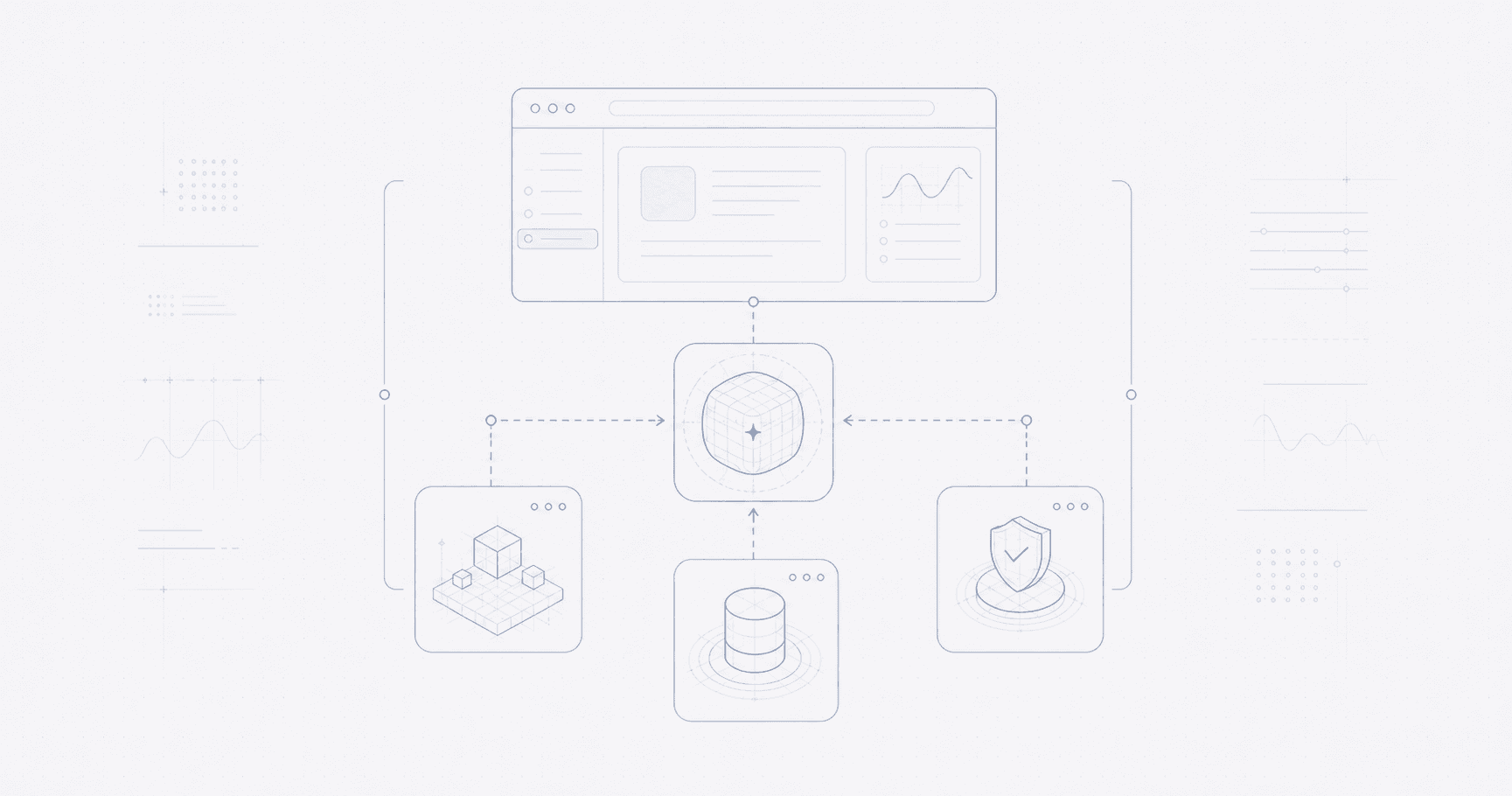
The agent belongs inside the workflow
The strongest agents live where the work happens. In the DjiniousLab assistant pattern, the agent panel is part of the application. It can read the current canvas and notebook, stream an answer, expose tool calls as structured cards, and keep the conversation tied to the project. That is materially different from copying screenshots into a separate chatbot.
For a customer app, the same principle applies. A finance agent should understand the selected account, current report, permissions, and audit requirements. A design agent should understand the selected component, theme tokens, and version history. A field-service agent should understand the asset, maintenance record, parts availability, and safety procedure. Context is the product feature.
Define a tool surface like an API
A reliable agent integration starts with tools, not prompts. Tools should be small, typed, observable, and attached to product permissions. Read tools inspect state. Draft tools prepare changes. Write tools mutate state only through approved paths. Every tool should have clear inputs, outputs, errors, idempotency expectations, and an audit event.
This discipline prevents the agent from becoming an unreviewable side channel. When the user sees read canvas, create draft, update parameter, or run validation, they can understand what happened. When engineering sees the same event in logs, they can debug it like any other product workflow.
Approval is part of the interface
Many teams treat approval prompts as a safety afterthought. They are actually a central UX pattern. The user should see what the agent wants to do, why it wants to do it, what will change, which objects are affected, and whether the action can be undone. Approval should be fast, but not vague.
Different actions deserve different policies. Reading current state may be automatic. Creating a draft may be automatic. Sending a customer message, changing a price, deleting data, moving money, or commanding equipment should require explicit confirmation or be forbidden entirely. The policy should be editable by the organization, not hardcoded in a hidden prompt.
Memory, evaluation, and operations
Persistent memory is useful only when it is scoped and inspectable. Project conventions, preferred formats, domain language, and stable user preferences can improve quality. Hidden memory that changes behavior without visibility damages trust. The user or administrator should be able to see, edit, and clear what the agent remembers.
The production work is then evaluation and operations: regression prompts, golden tasks, tool-call replay, cost budgets, latency budgets, abuse handling, and incident review. An agent becomes a serious product capability when it can be tested, monitored, and improved without guessing.